
Blog
How to Keep a Trading Journal: A Step-by-Step System That Sticks
Learn what to log after every trade, build a daily and weekly review routine, and use a simple template so your trading journal actually improves performance.
Screenshots show the VeloTape product interface (sample data for illustration).
Most traders know they should keep a trading journal. Fewer than half still do it after a month. The gap is not motivation — it is friction, vague rules, and reviews that feel like homework instead of feedback.
This guide shows how to keep a trading journal with a system you can run in under thirty minutes per week: what to log, when to review, a copy-paste template, and how to read your data without fooling yourself.
If you have not chosen a tool yet, start with our free trading journal guide — then come back here for the routine.
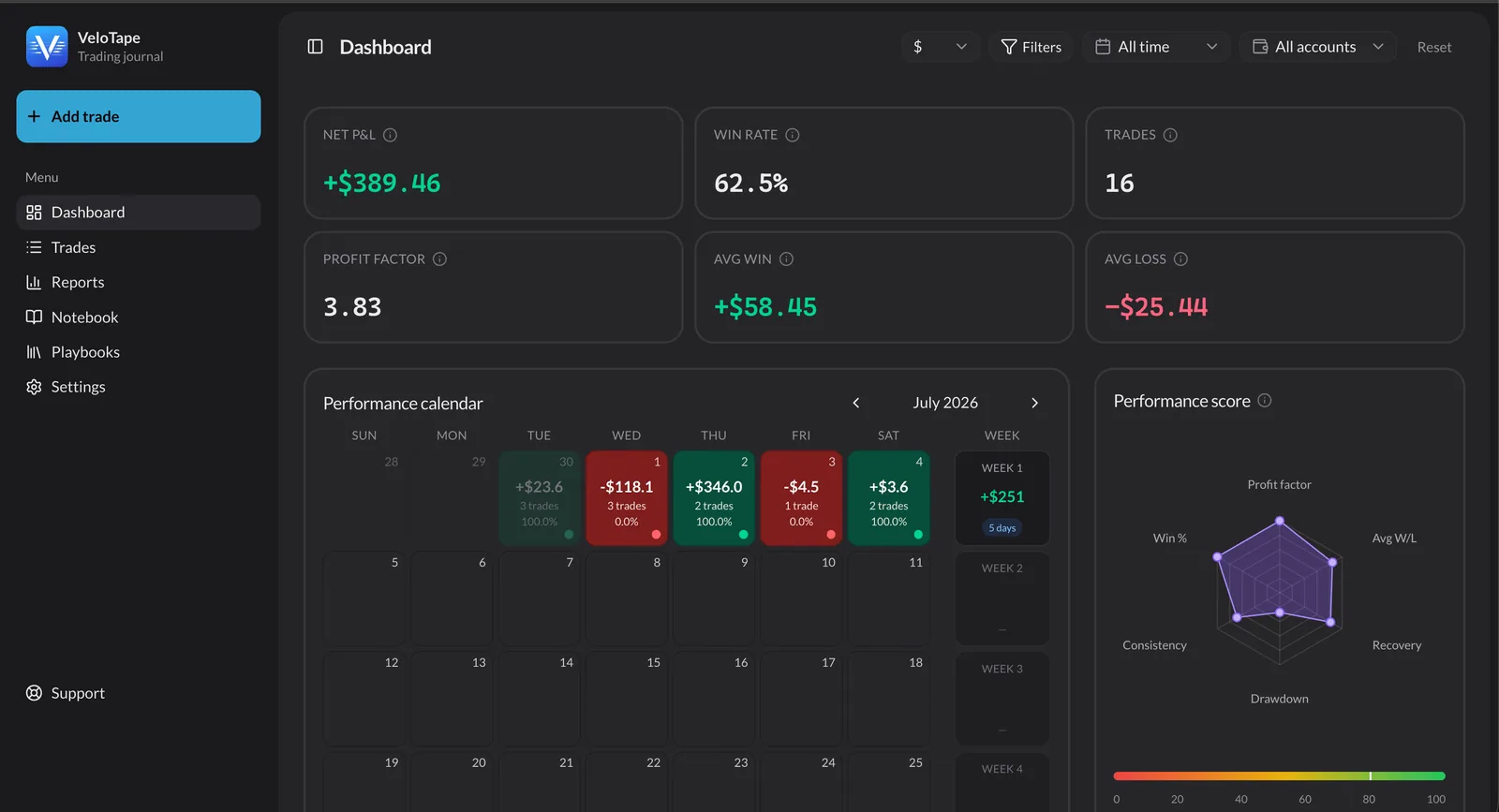
What to log for every trade (minimum viable journal)
You do not need a novel per fill. You need enough data to answer one question later: "Would I take this trade again under my rules?"
Execution layer (non-negotiable)
Log these fields for every trade — win or loss:
- Symbol / market — ES, NQ, AAPL, EURUSD, etc.
- Direction — long or short.
- Entry and exit — prices or times, plus position size.
- Net P&L — after commissions and fees.
- Setup tag — one label: breakout, pullback, reversal, news, etc.
VeloTape imports most execution fields from broker sync or CSV. You add tags and notes on top.
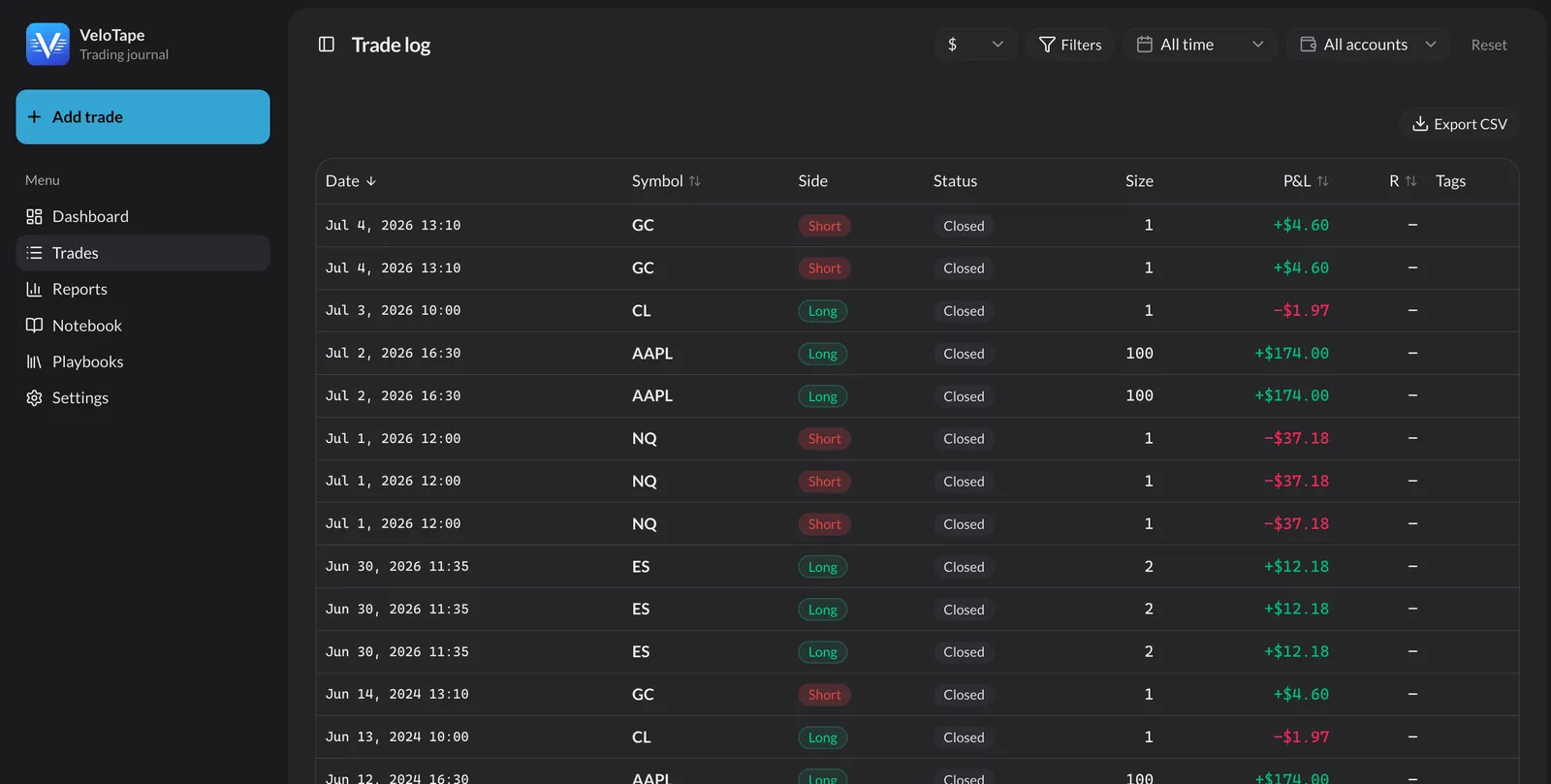
Context layer (add after two weeks)
Once logging feels automatic, add:
- Session — pre-market, open, midday, close.
- Plan adherence — did you follow your rules? (yes / partial / no)
- One-line rationale — why you entered, in plain language.
- Screenshot — chart at entry or exit (optional but powerful for pattern review).
Psychology layer (optional, not day one)
Emotion tags — FOMO, revenge, boredom, confidence — help explain why rules break. Add them only after execution logging is boringly consistent.
Rule: if a field makes you skip logging, delete it until next month.
The daily routine (5–10 minutes after each session)
Journaling works when it is tied to a fixed trigger — not when you "feel like it."
Step 1 — Confirm every fill is captured
Before you analyze anything, make sure today's trades are in the system. Sync your broker or drop in a CSV export. Missing trades are the fastest way to lose trust in your stats.
Step 2 — Tag each trade with one setup
Pick from your short list (three to five tags max). Consistency beats granularity. "Breakout" and "breakout-v2" are not two tags — they are clutter.
Step 3 — Write one sentence on your worst trade
Not your best trade. The worst trade of the session teaches more. Example: "Entered before confirmation because I did not want to miss the move."
Step 4 — Note one rule for tomorrow
End every session with a forward-looking line: "No trades in first five minutes." or "Max two attempts on NQ reversal setup." This closes the loop between review and behavior.
Time cap: set a timer for ten minutes. When it rings, stop. Perfect notes are less valuable than a repeatable habit.
The weekly review (20 minutes, non-negotiable)
Daily logging keeps data honest. Weekly review is where improvement happens.
Block the same slot every week — Sunday evening or Monday pre-market works for most futures and equity traders.
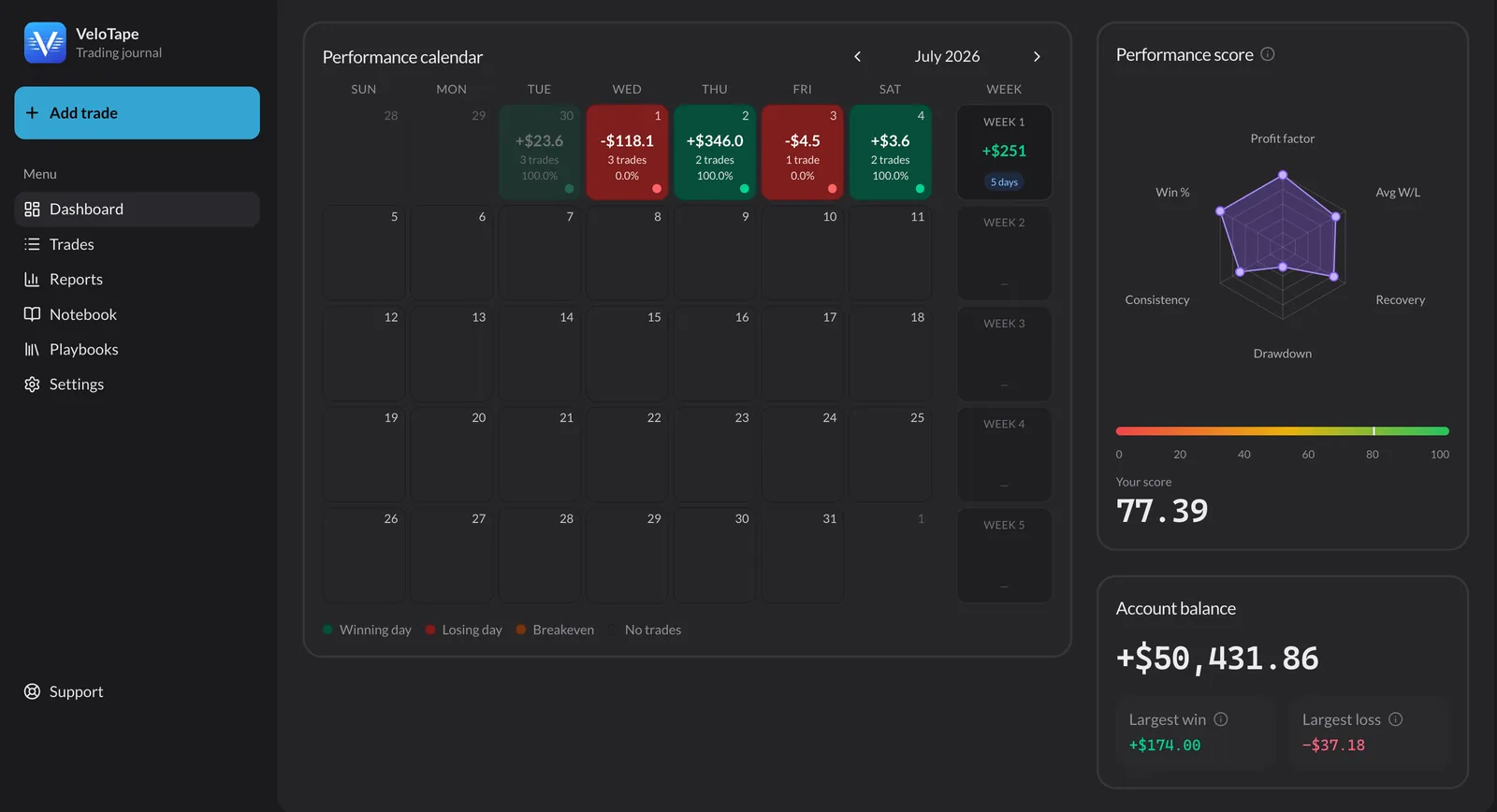
Weekly checklist
- Open the performance calendar — scan red clusters. Which weekdays bleed? Which sessions run hot?
- Sort by setup tag — which strategy made money? Which lost over the last five sessions?
- Read notes from losing days — look for repeated phrases: late entry, oversized size, trading outside plan.
- Pick one fix for next week — only one. "Reduce size on first trade of day" beats a list of ten resolutions.
- Export or screenshot one insight — optional, but it reinforces accountability.
VeloTape calculates win rate, profit factor, and setup breakdowns from the same log — no pivot tables.
The monthly audit (45 minutes, first weekend of the month)
Weekly reviews fix behavior. Monthly audits fix strategy and risk.
Once per month:
- Compare net P&L by setup — keep, tweak, or retire strategies with negative expectancy.
- Check average win vs average loss — are you cutting winners too early?
- Review max drawdown for the month — does it fit your risk plan?
- Update your playbook — one page of rules, screenshots, and invalidation criteria.
If a setup has not appeared in thirty days, archive its tag. Clarity beats completeness.
A trading journal template you can use today
Copy this into VeloTape notes, a spreadsheet, or a doc. Fill it per trade or per session.
TRADE LOG (per fill)
- Date / time:
- Symbol:
- Side: long | short
- Entry / exit:
- Size:
- Net P&L:
- Setup tag:
- Followed plan? yes | partial | no
- One-line note:

SESSION WRAP (end of day)
- Best trade (why):
- Worst trade (why):
- Rule for tomorrow:
- Emotional state (optional):

WEEKLY REVIEW
- Calendar pattern noticed:
- Top setup this week:
- Leak to fix next week:
- One metric to watch:
Start with the trade log block only. Add session wrap after ten days. Add weekly review once daily logging sticks.
Example journal entry (futures day trade)
Trade: ES long, breakout setup, +$420 net
Execution: Entered on opening-range high break, 2 contracts, exit at 1R target.
Plan adherence: Partial — entered one tick early before full candle close.
Note: Edge was valid; execution was impatient. Same setup with confirmation would be A+.
Weekly tag rollup: Breakout trades — 4 wins, 1 loss, +$890 net over five sessions.
That is enough. You do not need to justify the trade for three paragraphs. You need enough honesty to change behavior next week.
How to review your journal without bias
Your brain will defend bad habits. Build these guardrails into how you keep a trading journal:
Review losers first
Green days feel smart. Red days hold the lessons. Sort losing trades before winners in every weekly session.
Use numbers, not stories
If your journal says "I traded well" but profit factor dropped, trust the metric. Stories follow P&L; they do not replace it.
One change at a time
Traders who rewrite their entire system every bad week never learn what actually failed. Change one rule, run it for twenty sessions, then evaluate.
Compare setups, not feelings
"What did breakout trades do this month?" is answerable. "Am I improving?" is not — unless you tie improvement to a specific metric.
Five mistakes that break the habit
- Logging only when you feel like it — tie journaling to session end, not mood.
- Too many tags and columns on day one — minimal fields first; expand later.
- Skipping weekly review — logging without review is archive, not improvement.
- Deleting losing trades — the journal only works if it is honest.
- Changing tools every few weeks — commit to one system for at least thirty sessions.
FAQ
How long should a trading journal entry take?
Five to ten minutes after each session once imports are set up. Manual entry takes longer — another reason broker sync or CSV beats typing fills.
Should I journal every trade or only losers?
Every trade. Winners define your edge; losers expose leaks. Partial logs produce false win rates and useless setup reports.
What is the best format for a trading journal?
The format you will use tomorrow. Apps like VeloTape reduce friction with auto-import and built-in analytics; spreadsheets offer full control at low volume.
How often should I review my trading journal?
Daily quick pass, weekly twenty-minute review, monthly deeper audit. The weekly calendar habit delivers the best return on time.
Can I keep a trading journal in Excel?
Yes — especially below ~50 trades per month. Active traders usually outgrow spreadsheets when manual entry and formula maintenance eat more time than trading.
Does VeloTape provide investment advice?
No. VeloTape is for journaling and analytics only. See our Terms for details.
Build the habit on a free journal today
You do not need perfect discipline on day one. You need a trading journal routine simple enough to repeat — and a tool that does not fight you after every session.
Create your free VeloTape account — no credit card required. Import your last thirty days, tag three setups, and run your first weekly review this weekend.
More guides

Free Trading Journal: The Complete Guide for 2026
Learn what to look for in a free trading journal, how to start in 10 minutes, and when a dedicated app beats spreadsheets — no credit card required.

5 Trading Journal Metrics Every Trader Should Track
Win rate, profit factor, expectancy, max drawdown, and time-of-day performance — what each metric means, the formulas, and how to read them in your journal.

What to Record in a Trading Journal (Template Included)
Know exactly what to record in a trading journal — must-have fields, optional context that reveals edge, and a copy-paste template you can use today.
Trading involves substantial risk. VeloTape is for journaling and analytics only — not investment advice.